


Service vs. Product Operations Manager: Which Does Your Small Business Actually Need?
You know that feeling when you’re working harder than ever, but your business still feels chaotic? When you’re constantly putting out fires instead of focusing on growth? When you know something needs to change, but you’re not sure what?
That’s usually the moment when business owners realize they need operational support. But here’s where it gets confusing: not all operations managers do the same thing. The type of support you need depends entirely on what kind of business you’re running.
At Wasson Management + Marketing, we’ve worked with over 40 businesses helping them figure out exactly what kind of operational support will actually move the needle. Today, we’re breaking down the two main types of operations managers (service-focused and product-focused) so you can understand which one your business needs (or if you need both).
By the end of this guide, you’ll have clarity on what kind of help to hire, what they should be doing, and how to know if you’re making the right choice for your business.
What Is an Operations Manager (and Why Do Small Businesses Need One)?
Let’s start with the basics. An operations manager, also known as an Online Business Manager or OBM, is the person who makes sure your business actually runs smoothly behind the scenes.
Think of them as the conductor of an orchestra. You might have talented musicians (your team), great music (your products or services), and an audience ready to listen (your customers). But without someone coordinating everything, making sure everyone plays at the right time, and ensuring the whole performance flows seamlessly? It’s chaos.
What Operations Managers Actually Do:
- Manage and optimize business processes
- Coordinate teams and ensure accountability
- Bridge the gap between strategy and execution
- Identify bottlenecks and solve operational problems
- Create systems that make your business run on autopilot
- Handle the details that keep everything moving forward
The Key Distinction: Operations managers can work on-site or remotely (that’s why they’re often called Online Business Managers). Remote OBMs offer the flexibility to support your business from anywhere, which reduces overhead costs while still delivering exceptional results.
Why Small Businesses Need This Role: When you’re small, you’re probably doing everything yourself… sales, marketing, customer service, product development, team management, and oh yeah, actually delivering your product or service. Something has to give.
An operations manager takes the operational chaos off your plate so you can focus on what actually grows your business: strategy, relationship-building, and doing what you’re uniquely great at.
But here’s the thing: not all operations managers focus on the same areas. That’s where understanding the difference between service operations and product operations becomes critical.
The Service Operations Manager: Creating Exceptional Customer Experiences
A service operations manager is all about the customer experience. Their primary focus is making sure every interaction your customers have with your business is smooth, professional, and leaves them wanting to come back.
If your business is primarily service-based, whether that’s coaching, consulting, professional services, healthcare, beauty services, or anything where the “product” is actually an experience or expertise. This is probably the type of operations manager you need.
What Service Operations Managers Actually Focus On
1. Customer Experience Enhancement
Every single touchpoint with your customers should feel intentional and professional. A service operations manager maps out the entire customer journey and identifies where things could be smoother.
This includes:
- How easy is it for customers to book appointments or consultations?
- Do they receive confirmation emails immediately?
- Are they reminded about upcoming appointments?
- What happens after service is delivered—do you follow up?
- How do you handle customer complaints or issues?
- What’s the experience like for repeat customers vs. new ones?
Example: If you’re a business consultant, your service operations manager ensures that from the moment someone inquires about your services to the final deliverable, everything feels seamless, professional, and well-organized.
2. Streamlining Customer-Facing Processes
The goal is to make interactions with your business as effortless as possible, for both customers and your team.
This might mean:
- Automating appointment scheduling so customers can book 24/7
- Creating templates for common customer communications
- Setting up systems for intake forms, contracts, and payments
- Designing workflows that reduce wait times
- Eliminating redundant steps that frustrate customers
Example: Instead of playing email tag to schedule appointments, your service operations manager implements an automated booking system that syncs with your calendar, sends confirmations, and collects necessary information upfront.
3. Team Training and Resource Management
Your customer-facing team members need the right tools, training, and support to deliver exceptional service consistently.
This includes:
- Creating training materials and onboarding processes
- Ensuring team members have the tools they need (software, scripts, resources)
- Developing standard operating procedures (SOPs) for common scenarios
- Coaching team members on customer service best practices
- Creating systems for team communication and collaboration
Example: If you have virtual assistants handling customer inquiries, your service operations manager creates response templates, escalation procedures, and guidelines so every customer gets a consistent, high-quality experience regardless of who responds.
4. Feedback Collection and Implementation
Customer feedback is gold, but only if you actually use it. Service operations managers create systems to collect, organize, and act on customer feedback.
This looks like:
- Sending post-service surveys
- Monitoring reviews and testimonials
- Tracking customer satisfaction scores (CSAT or NPS)
- Identifying patterns in feedback
- Translating feedback into actionable improvements
Example: Your service operations manager notices that multiple customers mention confusion during onboarding. They redesign the onboarding process, add a welcome video, and create a checklist, resulting in better customer satisfaction scores.
5. Metrics Tracking and Optimization
You can’t improve what you don’t measure. Service operations managers track key metrics and use data to identify opportunities for improvement.
Important metrics for service businesses:
- Customer satisfaction scores
- Response time to inquiries
- Appointment no-show rates
- Customer retention rates
- Net Promoter Score (NPS)
- Time from inquiry to conversion
- Customer lifetime value
Example: By tracking metrics, your operations manager discovers that appointment reminders sent 24 hours in advance reduce no-shows by 40%. They implement this system across all services.
Real-World Example: Service Operations Manager for a Female Business Consultant
Let’s get really specific. Imagine you’re a business consultant who’s phenomenal at helping clients scale their businesses. Your one-on-one coaching sessions transform how people run their companies. Your group programs deliver incredible results.
But behind the scenes? You’re drowning.
The Problems:
- New clients don’t get onboarded smoothly, you’re manually sending contracts, scheduling calls, and explaining how everything works
- You spend hours each week on administrative tasks instead of actual coaching
- Your launches feel chaotic and stressful every single time
- Team members aren’t always clear on priorities
- Client communications fall through the cracks
- You’re constantly working “in” your business instead of “on” it
How a Service Operations Manager Transforms This:
Automated Client Onboarding: Your OBM builds a complete onboarding system. When someone signs up:
- Contracts are automatically sent via DocuSign
- First session is scheduled through Calendly
- Welcome email with all program materials goes out
- Access to any portals or resources is granted
- Payment processing is handled automatically
- Follow-up check-ins are scheduled
New clients feel supported and professional from day one, and you didn’t lift a finger.
Streamlined Launch Process: Whether you’re running live programs or setting up evergreen courses, your OBM creates templates and processes that make launches predictable and smooth.
This includes:
- Launch timelines with every task mapped out
- Email sequences written and scheduled
- Social media content planned and created
- Sales page copy templates
- Tech setup checklists
- Post-launch debrief processes
You go from stressed-out launches to confident, repeatable systems.
Team Management and Accountability: Your OBM uses project management tools (like Asana, ClickUp, or Monday.com) to:
- Assign tasks with clear deadlines
- Track progress on all projects
- Ensure designers, VAs, and contractors stay aligned
- Hold weekly team check-ins
- Document processes so nothing depends solely on one person
Your team knows exactly what they’re responsible for, and you have visibility into what’s getting done.
The Result: You spend your time doing high-value coaching work—the thing that actually makes money and fulfills you. Everything else runs smoothly in the background, managed by someone who excels at operations.
This is what service operations management looks like in action. It’s not just about delegating tasks—it’s about creating systems that make excellent customer service happen consistently, without you being the bottleneck.
The Product Operations Manager: Optimizing Internal Processes and Delivery
A product operations manager focuses on the internal processes that ensure your product or deliverable gets created, delivered, and refined efficiently. Their primary concern is team coordination, workflow optimization, and making sure what you promise gets delivered on time and at quality.
If your business involves creating and delivering products, whether that’s physical products, digital courses, software, installations, or complex service deliverables, this is likely the type of operations manager you need.
What Product Operations Managers Actually Focus On
1. Process Optimization and Workflow Management
Product operations managers look at how work actually flows through your business and identify where things get stuck, delayed, or inefficient.
This includes:
- Mapping out current workflows (how does something go from idea to delivered product?)
- Identifying bottlenecks that slow things down
- Redesigning processes to be more efficient
- Creating standard operating procedures (SOPs)
- Implementing tools that streamline production or delivery
Example: If you’re a health coach who creates meal plans and workout programs, your product operations manager maps out exactly how programs get created, from client assessment to customized plan delivery, and finds ways to make that process faster and more consistent.
2. Data Management and Feedback Integration
Product operations managers collect data about how products or deliverables are performing and use that information to make improvements.
This looks like:
- Gathering customer feedback about products
- Tracking which features or offerings are most popular
- Identifying common issues or complaints
- Prioritizing improvements based on data
- Presenting insights to decision-makers
- Creating feedback loops that continuously improve offerings
Example: Your product operations manager analyzes feedback from your online course students and discovers that Module 3 is where most people get stuck. They work with your instructional designer to add additional support resources, resulting in higher completion rates.
3. Team Alignment and Cross-Functional Coordination
Products rarely get created by one person, they require collaboration between multiple team members or departments. Product operations managers act as the bridge ensuring everyone stays aligned.
This includes:
- Facilitating communication between sales, marketing, and operations
- Ensuring everyone understands timelines and deliverables
- Coordinating handoffs between team members
- Running project meetings and status updates
- Resolving conflicts or misalignments
- Keeping projects on track and on budget
Example: When launching a new digital product, your product operations manager coordinates with your copywriter (for sales page), designer (for graphics), tech VA (for setup), and marketing team (for promotion), ensuring everyone knows their role and deadline.
4. Tool Management and Systems Implementation
Product operations managers oversee the software, tools, and systems that your team uses to create and deliver products efficiently.
This includes:
- Selecting the right tools for your business needs
- Implementing new systems and training team on them
- Integrating tools so they work together seamlessly
- Maintaining and troubleshooting technical systems
- Evaluating whether current tools are still serving your needs
Example: Your product operations manager implements a project management system like Asana or ClickUp, sets up automation between your email platform and CRM, and creates dashboards so you can see project status at a glance.
5. Quality Control and Delivery Standards
Ensuring that what gets delivered meets your standards every single time is a core responsibility of product operations managers.
This looks like:
- Creating quality checklists
- Establishing delivery standards
- Implementing review processes
- Tracking delivery timelines
- Addressing quality issues proactively
Example: Before any course module goes live, it goes through your product operations manager’s quality checklist: videos are properly edited, resources are uploaded, quizzes are tested, and everything functions correctly.
Real-World Example: Product Operations Manager for a Health & Wellness Coach
Let’s paint another specific picture. You’re an expert health and wellness coach. You’re amazing at motivating clients, creating transformative programs, and helping people achieve their fitness goals.
You offer:
- One-on-one coaching sessions
- Group fitness classes
- Online workout programs
- Nutrition guides and meal plans
- A membership community
You’re great at the coaching part. But behind the scenes? Things feel chaotic.
The Problems:
- New clients don’t get onboarded smoothly, sometimes they don’t receive access to resources right away
- Your team (video editor, graphic designer, social media VA) isn’t always clear on priorities
- Content creation feels rushed—you’re scrambling to post on Instagram or send newsletters
- You spend too much time managing the details of your programs instead of coaching
- Launches of new programs feel stressful and disorganized
- You’re not sure if your team is actually on track with their tasks
How a Product Operations Manager Transforms This:
Team Accountability and Project Management: Your OBM implements a project management system where:
- Every team member has clear tasks with deadlines
- You can see at a glance what’s being worked on
- Weekly check-ins ensure nothing falls through cracks
- Video editor knows exactly what needs editing and when
- Social media VA has a content calendar planned weeks in advance
- Everyone knows their role in upcoming launches
No more “Did you finish that thing?” messages. Everything is tracked, visible, and accountable.
Automated Client Onboarding: Your OBM creates a seamless onboarding process:
- Welcome email goes out immediately after purchase
- First coaching session is automatically scheduled
- Access to fitness app, meal plans, and resources is granted instantly
- New clients receive orientation video explaining everything
- Follow-up check-ins are scheduled at key milestones
Every new client has a consistent, professional experience, and you didn’t manually do any of it.
Streamlined Content Scheduling: Your OBM sets up systems for:
- Batching workout content (film once, use for weeks)
- Scheduling Instagram reels, stories, and posts in advance
- Planning email newsletters around program themes
- Organizing resources (meal plans, workouts) in easily accessible folders
- Creating content calendars that map out months in advance
You go from scrambling daily to having a strategic, organized content system that runs smoothly.
Program Launch Coordination: When you launch a new program or challenge, your OBM:
- Creates the launch timeline with every task assigned
- Coordinates between designer (graphics), copywriter (sales page), tech VA (setup)
- Ensures all systems are tested before launch
- Manages the waitlist and enrollment process
- Handles post-launch follow-ups and surveys
Launches become predictable and stress-free instead of chaotic fire drills.
The Result: You spend your time coaching, creating amazing content, and building relationships with your community, the high-value activities that grow your business. Your OBM handles the operational details, team coordination, and systems that make everything run smoothly behind the scenes.
This is product operations management in action for a service-based business with significant deliverables and team coordination needs.
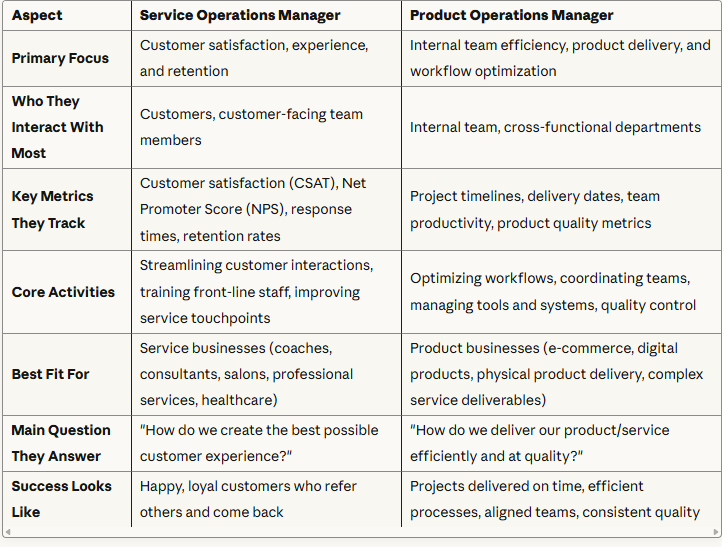
Service vs. Product Operations Manager: Key Differences at a Glance
Let’s make this crystal clear with a side-by-side comparison:
How to Know Which Type of Operations Manager Your Business Needs
Still not sure which one fits your business? Let’s walk through some scenarios and questions to help you decide.
You Probably Need a Service Operations Manager If:
Your Business Model:
- Your primary offering is expertise, advice, or a service experience
- Revenue comes from appointments, sessions, consultations, or retainers
- Customer relationships are central to your business model
- You sell coaching, consulting, professional services, or hands-on services
Your Current Challenges:
- Customers aren’t having consistent experiences
- Onboarding new clients feels chaotic
- You’re losing customers and don’t know why
- Customer inquiries aren’t being responded to quickly enough
- Scheduling and appointment management is a mess
- You don’t have systems for following up with customers
- Team members aren’t providing consistent service quality
What Keeps You Up at Night:
- “Are my customers happy?”
- “How do I create a more professional experience?”
- “Why do some customers love us and others disappear?”
- “How do I make sure every customer gets the same great experience?”
Your Growth Goal: You want to scale your service business while maintaining (or improving) customer satisfaction and retention.
You Probably Need a Product Operations Manager If:
Your Business Model:
- You create and deliver products (physical, digital, or complex service deliverables)
- Multiple team members or contractors contribute to what gets delivered
- Your offerings involve creation, production, or installation processes
- You sell courses, programs, physical products, software, or complex packages
Your Current Challenges:
- Projects aren’t getting completed on time
- Team members aren’t aligned on priorities
- Quality is inconsistent
- You’re the bottleneck—everything waits for you
- Workflows feel inefficient and clunky
- Too much time is spent on coordination and communication
- Launches feel chaotic with lots of last-minute scrambling
What Keeps You Up at Night:
- “Will we actually finish this on time?”
- “Is everyone on my team doing what they’re supposed to?”
- “How do I make our processes more efficient?”
- “Why does everything take so long to get done?”
Your Growth Goal: You want to scale your business by creating efficient, repeatable systems that don’t depend entirely on you being involved in every detail.
You Might Need BOTH If:
Many businesses actually need elements of both service and product operations management. This is especially true if you:
- Have both customer-facing service elements AND complex deliverables
- Are scaling quickly and need support in multiple areas
- Have distinct teams handling customer experience vs. product/program creation
- Want comprehensive operational support
Options for Businesses That Need Both:
- Hire one highly skilled OBM who can handle both service and product operations (though this person needs to be experienced in both areas)
- Hire two specialized operations managers (one focused on customer experience, one on product/team efficiency)
- Start with the area causing the most pain and add the second type of support later as you grow
At Wasson Management + Marketing, we help businesses figure out exactly what they need and can provide comprehensive operational support that covers both areas when necessary.
The ROI of Hiring an Operations Manager: Is It Worth the Investment?
Let’s talk about the elephant in the room: operations managers aren’t cheap. Whether you’re hiring someone full-time, part-time, or on a contractor basis, it’s an investment.
But here’s what we’ve seen across dozens of businesses: The ROI almost always justifies the cost—often many times over.
Time Savings (And What That’s Actually Worth)
Scenario: You’re currently spending 15-20 hours per week on operational tasks:
- Client onboarding and scheduling
- Team coordination and check-ins
- Responding to customer questions
- Managing projects and deadlines
- Following up on tasks that didn’t get done
- Troubleshooting problems
- Creating and updating systems
Your time is valuable. If you bill at $150/hour (conservative for many consultants and coaches), those 20 hours represent $3,000 per week in potential revenue—$12,000 per month.
Even if an operations manager costs $3,000-5,000/month, you’re still coming out ahead because you can redirect those 20 hours toward revenue-generating activities.
Plus: You’ll probably earn more than your current rate once you have time to focus on business development, strategic partnerships, and higher-level client work.
Customer Retention and Lifetime Value
The Problem: Poor operational systems lead to customer churn. When onboarding is confusing, communication is inconsistent, or the experience feels disorganized, customers leave.
The Math:
- Average customer lifetime value: $5,000
- Current retention rate: 60% (meaning 40% churn)
- If you acquire 10 new customers per month, you’re losing 4 of them ($20,000 in lost lifetime value)
What Changes: A service operations manager improves the customer experience, increasing retention to 80%. Now you only lose 2 customers per month instead of 4—saving $10,000 in lifetime value every single month.
That alone can pay for the operations manager position.
Team Efficiency and Productivity
The Problem: Without clear systems and accountability, teams waste time:
- Waiting for direction
- Duplicating efforts
- Fixing mistakes that could have been prevented
- Unclear on priorities
What Changes: A product operations manager creates clear workflows, assigns accountability, and ensures everyone knows what they’re working on. Your team becomes 30-40% more productive without working more hours.
The Result: You get more done with the same team size, which means either:
- You can take on more clients without hiring
- You can deliver better quality with the same resources
- You can launch new offerings faster
Reduced Stress and Burnout
This one’s harder to quantify, but it matters:
- Better sleep because you’re not worrying about what you forgot
- More energy for strategic thinking
- Ability to actually take vacations
- Improved work-life balance
- Reduced risk of burnout that could derail your business
The bottom line: For most small businesses, hiring operations support pays for itself within 2-3 months through some combination of time savings, increased revenue capacity, improved retention, and team efficiency.
What to Look for When Hiring an Operations Manager
Okay, you’ve decided you need an operations manager. Now how do you find the right one?
Essential Skills and Experience
Service Operations Managers:
- Experience in customer service or customer experience roles
- Understanding of CRM systems and customer communication tools
- Strong organizational and process-design skills
- Empathy and customer-centric thinking
- Experience training or managing customer-facing teams
Product Operations Managers:
- Project management experience (and ideally certification)
- Familiarity with project management tools (Asana, ClickUp, Monday.com, etc.)
- Cross-functional team coordination experience
- Systems thinking and process optimization skills
- Technical aptitude with various software tools
For Both Types:
- Proactive problem-solving abilities
- Excellent communication skills
- Experience in your industry or with businesses similar to yours
- Strategic thinking (not just task execution)
- Comfort with ambiguity and figuring things out
Questions to Ask During the Interview Process
Their Experience:
- “What types of businesses have you supported operationally?”
- “Can you give me an example of a process you redesigned and what the results were?”
- “What tools and systems are you most comfortable with?”
- “How do you approach a new business where there aren’t established processes?”
The Working Style:
- “How do you prioritize when everything feels urgent?”
- “How do you handle situations where team members aren’t meeting deadlines?”
- “What’s your communication style and how often do you typically update business owners?”
- “How do you measure whether your work is successful?”
About Specific Scenarios:
- “If you noticed customers were consistently confused during onboarding, how would you address that?”
- “If a project is falling behind schedule, what steps would you take?”
- “How would you handle a situation where two team members have conflicting priorities?”
Red Flags to Watch For
- Lack of specific examples from previous work
- Vague answers about their process or methodology
- Over-promising (“I can fix everything in 30 days!”)
- Inability to adapt their approach to your business’s specific needs
- Poor communication during the interview process (if they’re disorganized now, they’ll be disorganized working for you)
- Resistance to using tools or systems you already have in place
Making the Hire: Full-Time, Part-Time, or Contractor?
Full-Time Employee:
- Best for: Established businesses with significant operational complexity
- Pros: Dedicated focus, deep integration into your business, availability
- Cons: Higher cost, commitment, benefits to manage
Part-Time or Fractional OBM:
- Best for: Growing businesses that need support but don’t need 40 hours/week
- Pros: More affordable, flexible, access to experienced professionals
- Cons: Shared attention with other clients, limited availability
Agency or OBM Service:
- Best for: Businesses that need comprehensive support and backup
- Pros: Team approach, someone always available, diverse expertise
- Cons: Higher cost than individual contractor, less personal relationship
At Wasson Management + Marketing, we offer Online Business Management as a service, which means you get the expertise of our entire team without having to hire, train, and manage an individual employee.
Common Mistakes When Implementing Operations Management
Even when you hire the right person, there are common pitfalls that can prevent you from getting the results you want:
Mistake #1: Not Giving Them Enough Authority
The Problem: You hire an operations manager but continue micromanaging or requiring your approval for every decision.
The Fix: Clearly define what decisions they can make independently and trust them to make those calls. If you’re going to second-guess everything, you’re not actually delegating.
Mistake #2: Unclear Expectations and Metrics
The Problem: You hire someone but haven’t defined what success looks like or what you want them to prioritize.
The Fix: Set clear goals and metrics in the first 30, 60, and 90 days. What should improve? By how much? How will you measure it?
Mistake #3: Not Investing Time in Onboarding
The Problem: You hand everything off and expect them to figure it out without context about your business, customers, or priorities.
The Fix: Invest 10-15 hours in the first two weeks to thoroughly onboard your operations manager. Share your vision, walk them through current processes, introduce them to the team, and explain your business model.
Mistake #4: Hiring for Today Instead of Tomorrow
The Problem: You hire for your current business size without thinking about where you want to be in 12 months.
The Fix: Hire someone who can grow with you. Find an operations manager who has experience at the next level you’re trying to reach, not just where you are now.
Mistake #5: Treating Them Like a VA Instead of a Strategic Partner
The Problem: You give them tasks to execute without involving them in strategy or decision-making.
The Fix: Operations managers should be strategic partners who understand your goals and can suggest improvements. Include them in planning conversations, not just execution.
Making It Work: Setting Up Your Operations Manager for Success
Once you’ve hired the right person, here’s how to ensure they can actually make an impact:
Week 1-2: Comprehensive Onboarding
- Share your business vision, mission, and values
- Walk through your current processes (even the messy ones)
- Introduce them to all team members and explain everyone’s roles
- Give access to all necessary tools and systems
- Share passwords, documents, and resources they’ll need
- Explain your customer journey from start to finish
- Review your biggest pain points and priorities
First Month: Assessment and Quick Wins
- Let them observe and document current processes
- Ask them to identify immediate improvement opportunities
- Implement 2-3 quick wins that demonstrate value early
- Establish communication rhythms (weekly check-ins, etc.)
- Begin building or refining systems
Second & Third Month: System Building and Implementation
- Create or refine major operational systems
- Implement project management tools and workflows
- Train team members on new processes
- Begin tracking key metrics
- Adjust based on what’s working and what isn’t
Month 4+: Optimization and Scaling
- Continuously refine processes based on data
- Identify opportunities for automation
- Scale systems as business grows
- Take on additional responsibilities as they master core functions
Your Next Steps: Getting the Operational Support You Need
By now, you should have a much clearer picture of:
- What operations managers actually do
- The difference between service and product operations focus
- Which type your business needs
- What to look for when hiring
- How to make the investment pay off
Here’s how to move forward:
Option 1: You’re Ready to Get Professional Operations Support
If you’re thinking “yes, I absolutely need this,” let’s talk about how we can help.
At Wasson Management + Marketing, we provide comprehensive Online Business Management services that cover both service and product operations. We’ve worked with over 40 businesses, helping them transform from chaotic to organized, from overwhelmed to optimized.
Schedule a free consultation and let’s discuss:
- What’s currently not working in your business operations
- Whether you need service operations, product operations, or both
- What systems and processes would make the biggest impact
- How we can take operations completely off your plate
We’ll be honest about whether we’re the right fit or if you need something different.
Option 2: You Want to Improve Operations Yourself First
Maybe you’re not ready to hire yet, but you know your operations need work. That’s perfectly valid.
Check out GrowthIQ—our resource for business owners who want to build better systems themselves. You’ll get:
- Templates for customer onboarding, project management, and team coordination
- Step-by-step guides for improving operational efficiency
- Systems you can implement at your own pace
- Strategic guidance without the full-service price tag
It’s perfect for DIY-ers who just need the right frameworks and tools.
Option 3: You’re Still Gathering Information
Keep learning and exploring. Bookmark this guide so you can come back to it when you’re ready to make a decision.
In the meantime, explore more resources on our blog about how different types of digital marketing work together and combining content marketing and SEO to support your business growth.
The Bottom Line: You Don’t Have to Run Your Business Alone
Here’s what we want you to take away from this guide:
Operations management isn’t a luxury—it’s essential for growth. Every successful business reaches a point where the founder can’t do everything anymore. The businesses that scale are the ones that bring in operational support before they’re completely drowning.
Service and product operations are different—and understanding which you need matters. Hiring the wrong type of support won’t solve your problems. Get clear on whether your biggest challenges are customer-facing or internal, and hire accordingly.
The investment pays for itself, often many times over. When you calculate time savings, improved customer retention, team efficiency, and reduced stress, operations support quickly becomes one of the highest-ROI investments you can make.
You don’t have to figure this out alone. Whether you work with us or find support elsewhere, get the help you need to build a business that runs smoothly without burning you out.
Your business deserves systems that work. Company clients & customers deserve consistent, excellent experiences. Your team deserves clear direction and accountability. And you deserve to focus on what you’re actually great at instead of being buried in operational chaos.
Ready to make it happen? Let’s talk about how we can support your business. We’re here to help you build the operational foundation that makes everything else possible.


view + leave comments . . .